
Key Takeaways
- Amazon SEO (Search Engine Optimization) optimizes on-page listing architecture and off-page traffic signals to rank product detail pages at the top of organic search results.
- Driving targeted external traffic, maximizing click-to-sale (CTS) conversion rates, and optimizing keyword intent signals accelerate algorithmic rank positioning under the A10 algorithm.
- Achieving top organic search placements drives long-term sales velocity, establishes category authority, and significantly lowers overall advertising acquisition costs.
Establishing organic visibility across Amazon search results requires systematic listing optimization and strategic traffic management across Seller Central, Vendor Central, and B2B channels.
Navigating Amazon’s search algorithm requires addressing the core drivers of conversion velocity, keyword relevancy, and account health.
This masterclass breaks down the 25 primary ranking factors governing the Amazon search engine, providing an actionable roadmap to achieve top organic placements under the direction of an eCommerce Fractional CMO.
What is Amazon SEO?
Amazon SEO (Search Engine Optimization) is the process of optimizing on-page product detail pages and off-platform traffic signals to rank listings at the top of organic search results for high-intent search queries.
When a shopper enters a query, Amazon’s search algorithm evaluates catalog items across three primary criteria:
- Keyword Relevance Matching
- Historical Conversion Rate (Click-to-Sale Velocity)
- Predicted Revenue Realization
Unlike standard web search engines, Amazon operates as a commercial marketplace. The search algorithm prioritizes listings that generate the highest unit sales and revenue per session.
Product search placements distinguish between paid ad placements and organic rank positioning:
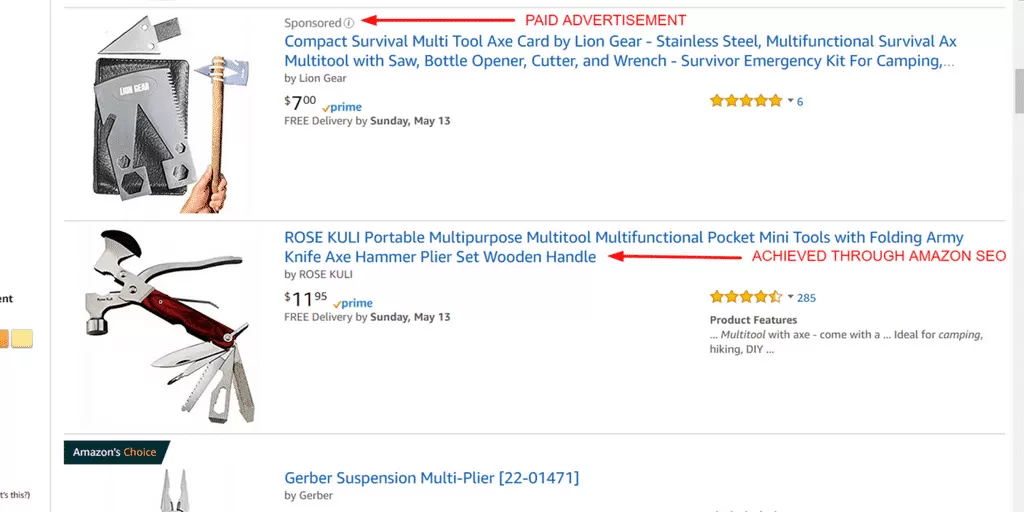
While the top position in search feeds often displays a paid Sponsored Products ad, organic search results beneath it capture baseline buyer traffic without direct click fees. Executing high-level Amazon Listing Optimization expands organic share of voice and helps reduce ACoS on Amazon across paid campaigns.
Core Evaluation Drivers Considered by the Search Algorithm:
- Best Sellers Rank (BSR) & Category Sales Velocity
- Competitive Landed Pricing
- Click-Through Rate (CTR) & Unit Session Percentage (Conversion Rate)
- Keyword Intent Relevancy (Frontend Copy & Backend Search Terms)
- Product Review Volume & Star Rating Averages (How To Get Amazon Reviews)
- Account Health Metrics (Order Defect Rate, Refund Rates, Fulfillment Speed)
What is Amazon A10? (The Amazon Search Algorithm)
Amazon A10 represents the algorithmic logic governing search indexing and product display priority across the Amazon marketplace platform.
Amazon explicitly details the operational focus of its search engine architecture:
“Our work starts long before a customer types a query. We’ve been analyzing data, observing past traffic patterns, and indexing the text describing every product in our catalog before the customer has even decided to search… We focus on the words and the intent behind those words.”
As an eCommerce Fractional CMO, I structure keyword strategy around buyer search intent rather than generic search volume. Search queries reflect distinct stages in the buying journey: research intent versus transaction intent.
Consider a broad discovery query like “Women’s Red Shoes”:
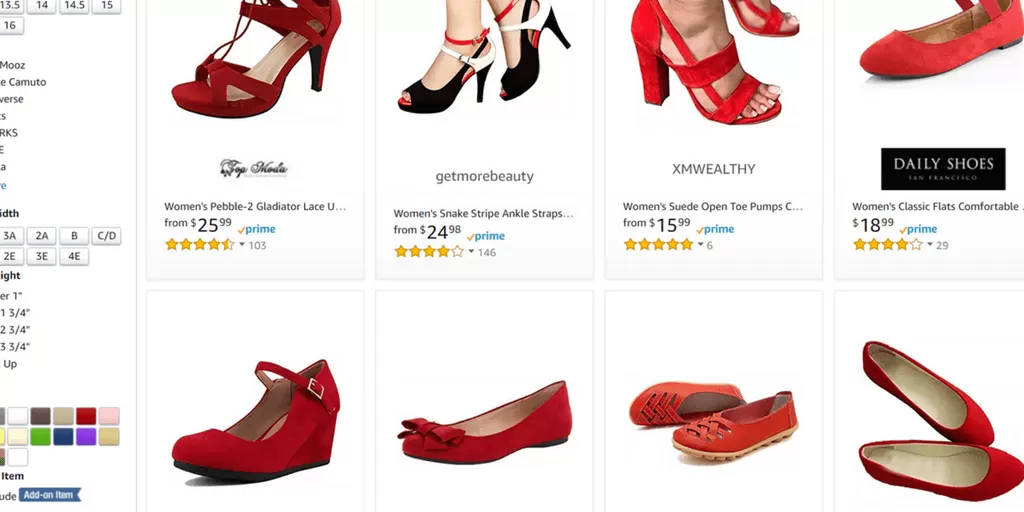
Broad search terms indicate early-stage research. Shoppers are browsing styles and categories without immediate intent to purchase.
Conversely, consider a precise long-tail query like “red women’s suede open toe pumps size 6”:
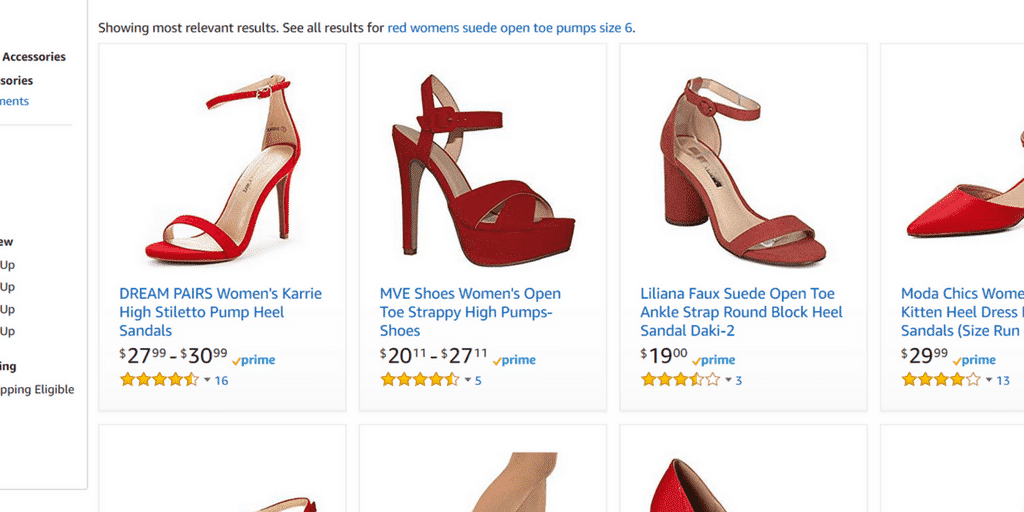
Long-tail intent queries reveal a customer who has defined their exact purchasing criteria (color, material, style, and sizing). Optimizing catalog listings for high-intent search queries yields significantly higher conversion rates and accelerates organic rank placement.
Primary Algorithmic Pillars of Amazon A10:
- Keyword Relevancy: Establishing direct semantic alignment between customer queries and detail page attributes.
- Unit Session Conversion Velocity: Demonstrating consistent transaction completion when buyers land on the page.
- Off-Platform Referral Traffic: Incentivizing brands to direct high-intent buyers from external traffic channels onto Amazon listings.
- Catalog Sell-Through Velocity: Maintaining active inventory turnover while archiving stagnant, non-performing catalog items.
- Click-Through Rate (CTR) Performance: Capturing high thumbnail click volume from search result impressions.
- Account Performance Metrics: Maintaining flawless fulfillment, low defect rates, and positive seller feedback.
How Does Amazon SEO Work?
Amazon A10 Algorithm Ranking Weights
*PPC ad sales drive immediate sales velocity, but organic sales carry significantly heavier weighting in long-term rank retention.
Amazon Search Engine Optimization depends on three core operational domains:
- On-Page Product Detail Page Factors
- Seller Account Health & Operational Metrics
- Off-Platform Referral Traffic Strategy
19 On-Page Product Listing Ranking Factors
| Ranking Factor | Algorithmic Function & Strategic Execution |
|---|---|
| 1. Best Sellers Rank (BSR) | Reflects relative sales velocity within a sub-category. Lower BSR numbers indicate higher conversion momentum. |
| 2. Keyword Integration | Avoid keyword stuffing. Integrate high-intent exact and phrase-match keywords across Titles, Bullets, and Descriptions. |
| 3. Feature Bullet Points | Structure bullet points to lead with customer benefits while incorporating secondary long-tail search terms. |
| 4. Product Description & A+ Content | Deploy rich visual modules and skimmable copy to drive conversions and capture backend image alt-text indexing. |
| 5. Brand Name & Part Number | Include exact Brand Name and Manufacturer Part Numbers in titles to capture direct branded search traffic. |
| 6. Technical Specifications | Populate all backend item attributes (size, color, material, weight) to match category search filter facets. |
| 7. Sub-Category Categorization | Assign products to the most specific sub-category leaf node to ensure accurate indexing. |
| 8. Backend Search Terms | Utilize all 250 bytes of generic search terms. Separate terms using single spaces without punctuation or repetition. |
| 9. Conversion Source Terms | Amazon tracks exact query strings generating purchases, strengthening rank for specific converting keywords. |
| 10. Click-Through Rate (CTR) | High CTR signals strong main image and title relevance, prompting the algorithm to expand impression share. |
| 11. Title Optimization | Front-load primary keywords within the first 67 characters to ensure legibility on mobile devices. |
| 12. Product Review Signals | Total review volume and star rating averages (4.3+ threshold) act as critical social proof signals. |
| 13. Main & Gallery Imagery | Publish 6+ high-resolution, zoom-enabled renders on pure white backgrounds (#FFFFFF) following image standards. |
| 14. Listing Completeness Score | Complete 100% of listing data fields in Seller Central to maximize algorithmic matching. |
| 15. Landed Price Point | Competitive pricing drives higher unit session percentages, directly lifting organic rank position. |
| 16. Parent-Child Variations | Consolidate size or color variations under parent ASINs to pool review volume and sales history. |
| 17. Dwell Time (Time on Page) | Longer customer engagement times signal listing quality and relevant content. |
| 18. Session Bounce Rate | High immediate exit rates signal irrelevant traffic or poor listing content, suppressing search rank. |
| 19. Customer Q&A Activity | An active, well-answered Questions & Answers section provides additional keyword context and overcomes objections. |
6 Seller Account Performance Factors
Amazon prioritizes search visibility for brand accounts demonstrating reliable fulfillment and operational excellence:
20. Seller Feedback Rating
Overall seller account feedback scores directly influence Buy Box rotation and organic search placement by proving account reliability.
21. Fulfillment Speed & Handling Time
Fulfilling orders promptly—either via FBA or rapid Merchant Fulfillment (FBM)—builds account trust and supports rank retention.
22. In-Stock Inventory Rate
Frequent stockouts erase accrued organic search authority. Maintaining consistent inventory replenishment protects rank investments.
23. Perfect Order Percentage (POP)
Tracks the proportion of customer orders executed flawlessly without buyer inquiries, returns, delays, or defect claims.
24. Order Defect Rate (ODR)
Measures the percentage of orders resulting in negative feedback, A-to-z Guarantee claims, or service chargebacks (must remain below 1%).
25. Platform Exit Rate
Tracks sessions where a shopper leaves Amazon entirely after visiting a listing. High exit rates signal poor listing match or bad customer experience.
Off-Platform Traffic Drivers
Directing external traffic onto Amazon product listings serves as an explicit algorithmic booster under A10:
1. Amazon Influencers & Creator Networks
Collaborating with niche creators to drive direct traffic via Amazon Attribution links generates high-converting sales velocity that lifts organic search rank.
2. Targeted Paid Media (Search & Social Ads)
Running off-platform ad campaigns (such as Google Search Ads or Meta Paid Social) directly to Amazon landing pages drives conversion momentum and earns referral fee credits under the Brand Referral Bonus program.
3. Owned Audience Channels (Email & SMS)
Mobilizing owned subscriber lists during product launches or promotional windows generates concentrated conversion spikes that establish early search indexing.
The Product Launch “Honeymoon Period”
When launching a new ASIN, Amazon’s algorithm assigns a temporary artificial boost in search exposure to evaluate sales performance.
Failing to optimize detail pages prior to catalog launch squanders this initial window, making subsequent ranking pushes more expensive.
Honeymoon Launch Strategy Checklist:
- Finalize 100% of listing copy, A+ Content, and renders prior to inventory activation.
- Launch targeted Sponsored Products campaigns on day one to capture high-intent exact match keywords.
- Mobilize owned email subscriber lists to generate baseline conversion velocity immediately upon launch.
- Activate Creator partnerships to send steady external referral traffic.
- Enroll eligible ASINs in Amazon Vine to establish early compliant product reviews.
How To Use Amazon Keywords Step-by-Step
Step 1: Reverse-ASIN Competitor Mining
Extract primary competitors’ top-performing search terms using reverse-ASIN lookup tools (such as Helium 10 Cerebro or Jungle Scout) to identify converting keyword targets.
Step 2: Classify Search Query Intent
Segment keyword lists into high-converting Buyer Intent Terms (long-tail, specific attributes) and broad Brand Awareness Terms.
Step 3: Clean and Deduplicate Keyword Lists
Process keyword lists to eliminate duplicate words, special characters, and non-compliant competitor brand references, organizing terms for frontend and backend deployment.
Step 4: Populate Backend Search Terms & Subject Matter
- Utilize up to 250 bytes in the Generic Search Terms field.
- Separate terms using single spaces without commas, punctuation, or word repetition.
- Do not include competitor brand names, registered trademarks, or misleading attributes.
How To Check Keyword Indexing Status
Verify whether Amazon’s search engine has indexed your detail page for specific target search terms:
- Navigate to the Amazon search homepage.
- Ensure category selection is set to “All Departments”.
- Input your product ASIN followed by a single space and your target keyword into the search bar (e.g.,
B08PSJDC8R coffee pods). - Execute the search query. If your product appears in the search result, the ASIN is successfully indexed for that keyword.
How to Increase Keyword Rankings on Amazon
If your ASIN is indexed but remains buried on secondary search pages, execute these rank acceleration tactics:
1. Increase Unit Session Percentages
Optimize visual assets, pricing, and bullet points to elevate conversion rates. Higher unit session percentages signal search relevance, pushing listings up organic feeds.
2. Deploy Exact Match Google Ads
Target specific long-tail buyer intent search terms on Google Ads, routing converting traffic directly to your Amazon listing via Attribution links.
3. Align Exact Phrase Matches in Frontend Copy
Integrate exact phrase matches for primary target search terms within the Product Title, top two bullet points, and A+ Content image alt text.
4. Scale Targeted PPC Keyword Campaigns
Increase bid aggressiveness on exact-match Sponsored Products campaigns for target search terms to prove conversion relevance to the search algorithm.


![Seller Central vs Vendor Central [COMPARISON]](https://www.sourceapproach.com/wp-content/uploads/2026/02/Amazon-Seller-Central-vs-Amazon-Vendor-Central-The-Source-Approach-eCommerce-Fractional-CMO-Amazon-Consultant-eCommerce-Consultant.png)
![How To Drive External Traffic To Amazon Listings [GUIDE]](https://www.sourceapproach.com/wp-content/uploads/2025/07/How-To-Drive-External-Traffic-To-Amazon-Featured-Image-The-Source-Approach-Amazon-Consultant-eCommerce-Consultant-Fractional-CMO.png)

![How to Switch From FBA to FBM [Step By Step]](https://www.sourceapproach.com/wp-content/uploads/2025/07/How-to-Switch-From-FBA-to-FBM-The-Source-Approach-Amazon-Consultant-eCommerce-Consultant-Fractional-CMO.png)



![Amazon Storefront Design Templates [EXAMPLES]](https://www.sourceapproach.com/wp-content/uploads/2023/11/Amazon-Storefront-Templates-Source-Approach-Amazon-Consultant-eCommerce-Consultant-Fractional-CMO.png)